
The recent Better Media online consultation sessions brought together practitioners, advocates and policy observers to reflect on two live processes shaping the future of UK radio: Ofcom’s licensing review and the DCMS Radio Review. The purpose was not simply to respond to technical questions, but to examine what kind of broadcast ecology the UK intends to sustain over the next twenty years.
Download the Discussion Summary Here
Participants considered spectrum management, platform access, economic entry conditions, plurality of supply and the civic role of the BBC. Underlying each theme was a structural question:
Is policy drifting toward further consolidation, or can it be reoriented toward diversified supply and meaningful local accountability?
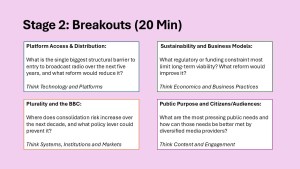 There was broad agreement that licensing frameworks alone do not determine outcomes. Multiplex governance, carriage pricing, technical standards, rights costs and discoverability on digital platforms all shape who can enter, who can grow, and who can survive. If licences exist, but access remains constrained, is the market genuinely open?
Local provision emerged as a defining issue. Is “local” still a democratic necessity, or merely a legacy category? If local knowledge, scrutiny and participation are diminished, what replaces them? Should regulators apply a clearer localism test to determine whether services meaningfully serve place, rather than simply brand themselves as such?
Participants also questioned whether scale-based metrics adequately capture public value. How should trust, belonging, civic literacy and social cohesion be recognised within broadcast policy? If citizen outcomes matter, what evidence framework is needed to demonstrate them credibly?
The sessions explored whether the BBC could act as an enabling institution within a plural system rather than as a dominant supplier. What forms of partnership, commissioning or shared infrastructure would strengthen local provision without compromising independence or distorting markets?
A further theme concerned integration. Should community and local radio be considered in isolation, or as part of a wider civic information ecosystem that includes local journalism, community arts, education, wellbeing networks and civil society bodies? If these fields share aligned public purposes, how might they collaborate more systematically?
The consultation did not produce a single fixed answer. Instead, it surfaced a coherent direction of travel. Broadcast policy reform should be assessed against one core principle: does it diversify supply and strengthen contestability, or does it consolidate control and narrow routes to entry?
Future discussions will explore these questions in more depth. How can the decentralising potential of current media technologies be harnessed to extend trusted provision, rather than reinforce centralised gatekeeping? What would a proportionate and sustainable cost regime look like for smaller providers? And how might a shared evidence spine be developed so that civic value claims are recognised within formal policymaking?
Better Media will continue the conversation through further blogs, podcasts and policy forums, inviting colleagues from aligned fields to contribute to a broader and more integrated reform agenda.