
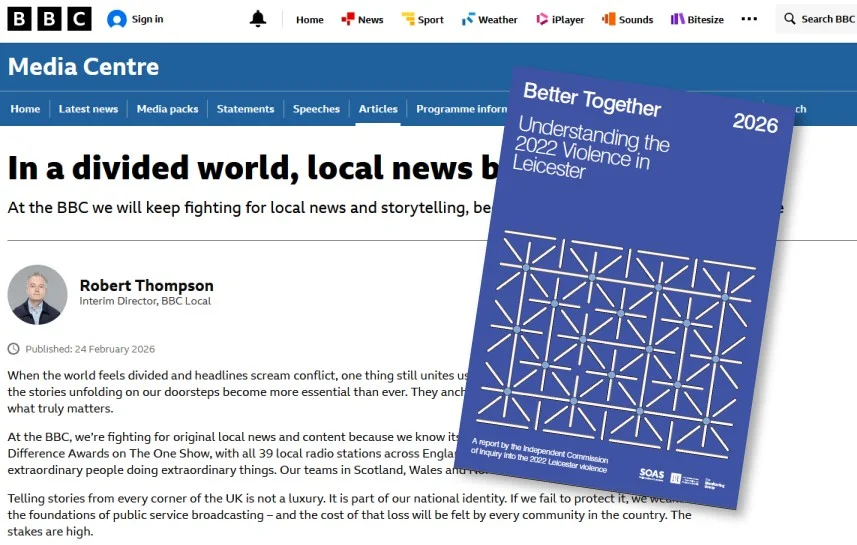
The SOAS report published this week identifies a clear vacuum in trusted, secular, intercultural and cross-community local media provision. In that vacuum, disinformation flourished. Narratives were shaped not by accountable local institutions, but by motivated international actors operating through networked platforms.
The absence of robust, locally embedded and trusted civic media created conditions in which rumour, grievance and strategic misinformation could escalate unchecked.
Against this background, it is difficult to reconcile claims about the unifying power of local news with lived experience in Leicester.
Before congratulating itself too vigorously, the BBC would improve public trust by offering a candid assessment of its systemic failures in local accountability. In the run up to 2022, the city required trusted, visible and facilitative local journalism capable of convening dialogue, clarifying facts and moderating tensions. Instead, many residents experienced distance, delay and generalisation. A public reckoning with these shortcomings would signal seriousness about renewal.
Join Our Discussion to Review the Report and to Consider What Next for Community and Independent Media in Leicester
Wednesday 18 March 2026
Arrivals from 5.45pm
Start time 6.00pm
Innovation Centre, De Montfort University
Book Your Place Here: https://luma.com/wb5xuyx4
The issue is structural. The process of regionalisation has progressively hollowed out genuinely local engagement. Production hubs are consolidated. Editorial decisions are standardised. Place-specific knowledge is diluted. The result is coverage that is technically competent but often socially detached. In moments of civic stress, that detachment becomes consequential.
The BBC should not approach Charter Renewal as a public relations contest in which reputational positioning takes precedence over institutional introspection. Trust is not built through assertion. It is built through accountability. That requires acknowledging deficiencies, biases and blind spots, particularly in relation to how local tensions are understood, framed and mediated.
If the BBC is unwilling or unable to provide genuinely local content and structured space for deliberation and cross-community discussion, then the regulatory framework should enable other providers to do so. Civic engagement is not a symbolic add-on to broadcasting. It is a foundational function in plural societies. Where institutional media withdraw, the space does not remain empty. It is occupied.
Absent reform, the risk is clear. Malign and malicious exploitation of information ecosystems will continue to intensify. If trusted, accountable and locally embedded platforms are not sustained, then credibility will erode further. At that point, the question will not be whether local news brings communities together. It will be whether legacy institutions have rendered themselves irrelevant to the communities they claim to serve.
Charter Renewal offers an opportunity. It should be used not to defend existing structures reflexively, but to rebuild a model of local media that is accountable, deliberative and genuinely rooted in place.