

The publication of the Independent Commission on Neighbourhoods’ green paper Delivering Neighbourhood Renewal: Proposals for Change marks a timely and ambitious moment for policymakers, local authorities, and civic institutions. With its focus on identifying “mission critical neighbourhoods” through the new Hyper-Local Needs Measure (HLNM), the report sets out a clear case for long-term, place-based investment in communities that have suffered from decades of underinvestment, economic decline, and structural neglect.
At Decentered Media, we welcome this shift in narrative and the move towards a more granular understanding of need. But we must also sound a note of caution: any serious attempt to support neighbourhood regeneration must include the infrastructure of communication—especially civic and community media—as a core part of what enables social cohesion, local identity, and democratic renewal.
The Limits of ‘Hyper-Local’ Thinking
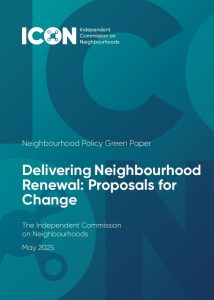 The report introduces the HLNM as a composite tool to locate neighbourhoods with the greatest need across health, crime, education, employment, and energy efficiency. While we endorse this targeted approach, we question the framing of this as “hyper-local.” In most cases, what is described is not beyond the realm of traditional locality—typically defined by Lower Super Output Areas (LSOAs). The hyperbole of “hyper-local” obscures a more important point: the fragmentation of identity and purpose at the neighbourhood level cannot be overcome by geographic designation alone.
For many people, especially in highly mobile, post-industrial, and digitally mediated environments, neighbourhoods are not necessarily places of rooted identification. The assumption that people naturally associate with the immediate geography they occupy no longer holds. The report rightly discusses the need to support identity-building from the ground up, but to do this effectively, communication processes must be embedded in the renewal framework.
Neighbourhoods Without News
Too many communities today are experiencing information deprivation. The collapse of local journalism, commercial pressures on media outlets, and the proliferation of “news deserts” have created hollowed-out public spheres. In many of the mission-critical neighbourhoods identified by the HLNM, people simply don’t know what is happening in their area, who is making decisions, or how they can participate. A healthy democracy and a functional local ecosystem require trustworthy, accessible, and participatory communication platforms.
This is where community media must come in—not as an afterthought or a funding footnote, but as a central plank of renewal policy.
Communication is Social Infrastructure
The report repeatedly highlights the importance of social infrastructure in supporting social capital and resilience. Yet, it omits to name community and civic media as anchor institutions. This is a serious oversight.
Just as libraries, schools, GP surgeries, and community centres are essential public goods, so too are community radio stations, local newsletters, independent blogs, neighbourhood podcasts, storytelling circles, photography projects, and grassroots vlogs. These tools are what make a community visible to itself. Without them, the possibilities for bonding social capital (the deepening of trust and solidarity within groups) and bridging social capital (the creation of relationships across groups) are dramatically reduced.
Communication isn’t just a means of delivery—it is a condition of social connection. In a fragmented and digitally mediated society, this means investment in media sensemaking as much as in bricks and mortar.
Regenerative Storytelling and the Foundational Economy
Community media operates according to principles that align deeply with the report’s underlying values: self-governance, co-production, and the regeneration of civic trust through storytelling. These are not luxuries; they are foundational. In the model of the Foundational Economy, where public goods are recognised not for their market value but for their public utility, community media should be seen as a peer social service—essential for democratic culture, local economic accountability, and wellbeing.
And like other foundational services, it must be anchored, not outsourced.
The Neighbourhood Test: A Communication Lens
The report proposes a “Neighbourhood Test” to be applied to all future policy and funding proposals, posing questions such as: What kinds of impact might the policy have on disadvantaged neighbourhoods? What kind of impact will it have on social infrastructure and social capital?
This test should be explicitly extended to include communication infrastructure:
- Will the policy enhance local media pluralism?
- Will it support democratic expression in and between neighbourhoods?
- Does it strengthen or weaken platforms for inclusive storytelling?
If we want to “think neighbourhoods,” then we must also “hear neighbourhoods”—and that means ensuring that neighbourhoods have the tools, platforms, and autonomy to speak for themselves.
A Call for Investment in Communication Capacity
Neighbourhood renewal is not just about service delivery. It’s about sensemaking—the collective process of understanding our environment, making decisions, and building a shared future. Without a strong media ecology, that sensemaking is stunted.
We therefore call on policymakers, funders, and local authorities to:
- Include civic and community media in all definitions of social infrastructure.
- Recognise community media organisations as anchor institutions in the renewal process.
- Apply the Neighbourhood Test to media and communication policies, not just to physical services.
- Fund community-led communication initiatives as a core element of social capital investment.
- Respect community media as a tool of local identity formation and democratic participation, not simply a channel for messaging or behavioural change.
The success of the government’s mission-led approach to national renewal will ultimately be determined by whether communities can develop a shared sense of purpose. That begins with communication. Let’s not leave media out of the neighbourhood conversation.
For consultation responses and policy engagement, Decentered Media will be submitting a formal response to the green paper by 25th July 2025, with particular emphasis on the role of communication ecosystems in democratic, cultural, and economic renewal.
If you value independent thinking on neighbourhood renewal and believe in the power of community media to shape public policy, consider supporting Decentered Media by becoming a Patreon subscriber. Your support helps us produce research, blogs, and policy submissions like this one—and gives you the chance to join the conversation. Let’s shape change together.