
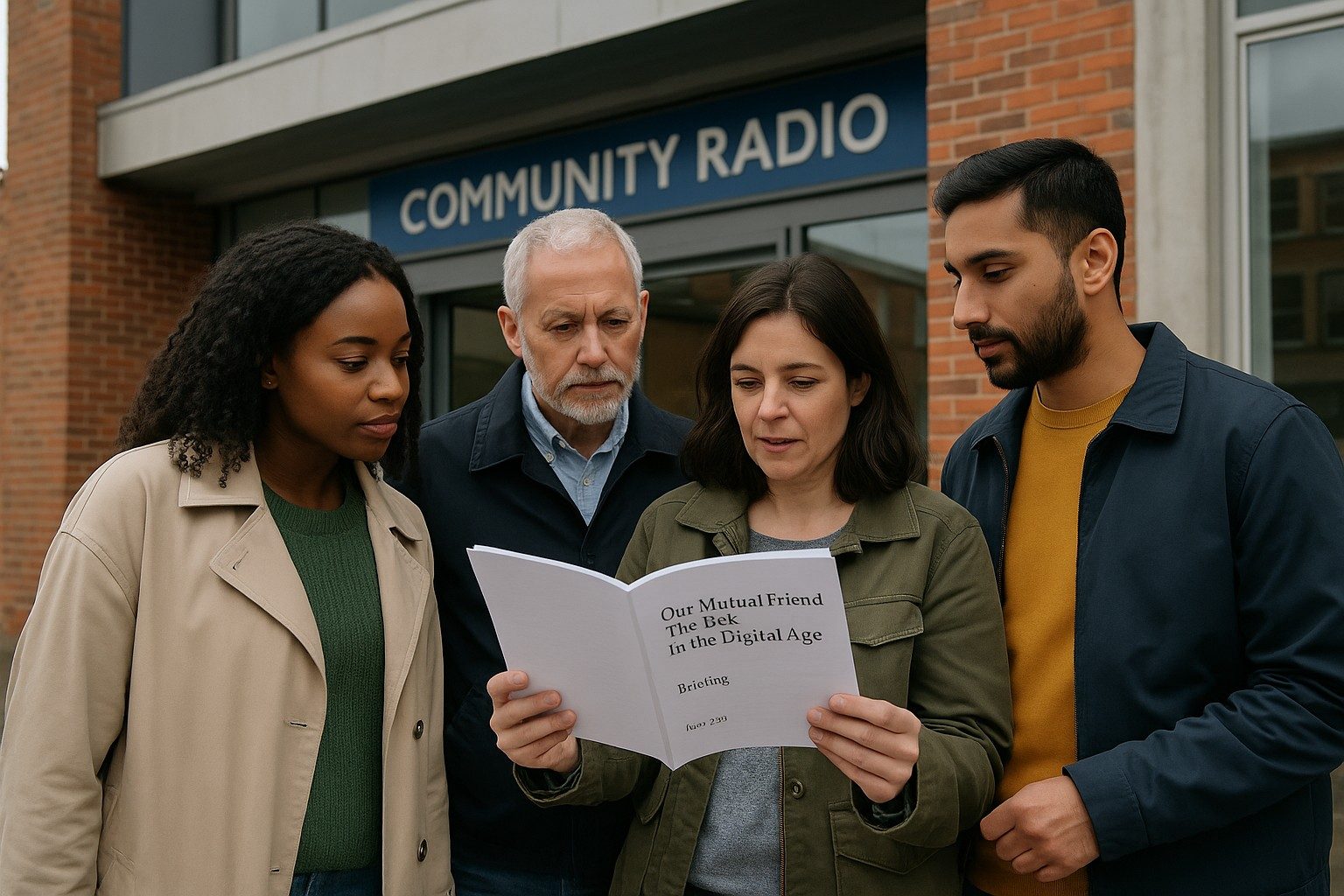
The recent proposal from Common Wealth and the Media Reform Coalition to mutualise the BBC represents a timely and much-needed intervention in the debate about the future of public service media in the UK. Their report, Our Mutual Friend: The BBC in the Digital Age, outlines an ambitious plan to reconstitute the BBC as a democratic, participatory mutual. This would see all UK residents become active members of the institution, empowered to influence its strategy, funding priorities, and editorial direction.
At Decentered Media, we welcome this proposal. It rightly identifies the critical need to ensure that the BBC is accountable to its audience, not beholden to central government or powerful corporate interests. The introduction of a Member’s Council, Members’ Panels, and participatory budgeting mechanisms would be a meaningful step toward restoring trust and transparency in how the BBC operates. The vision is clear: a BBC for everyone, owned by all, and governed in the public interest.
Yet while we support the direction of travel, we also want to ask a deeper question: why a national service at all?
The report identifies schools, libraries, and hospitals as potential partners in a more participatory BBC. These are welcome suggestions. But we must also consider whether media services rooted in these institutions would be better realised as locally governed and independently operated bodies, rather than as satellites of a reformed BBC.
The very civic structures that the BBC is being invited to work with—public libraries, adult education providers, civic trusts—already embody a decentralised logic. Embedding public media in these settings should not mean drawing them into a centralised structure, however democratic. Rather, it should mean resourcing them to develop locally accountable and mission-driven media practices in their own right.
This is not to reject mutualisation, but to ask whether it can be broadened. The report’s authors acknowledge the danger of “hollow mutualism”—participation that is symbolic rather than structural. They also recognise the importance of safeguarding editorial independence through real civic engagement, not just representation. But could we go further still? Could we imagine a public media commons made up of many civic-led organisations—each embedded in place, responsive to local need, and empowered through distributed infrastructure and platform technology?
Recognising the Role of Community Radio in Public Media Reform
While Our Mutual Friend: The BBC in the Digital Age presents a compelling and timely proposal for the democratic mutualisation of the BBC, one notable omission in the report is the lack of attention to Community Radio as an established and regulated model of local public service broadcasting in the UK.
Community Radio, licensed by Ofcom since 2005, operates on a not-for-profit basis, is embedded within the communities it serves, and is required to deliver social gain outcomes alongside broadcasting output. These stations are already engaged in many of the practices the report advocates for the future BBC: audience involvement in governance, partnerships with local civic institutions, and content production that is locally relevant, culturally inclusive, and democratically accountable.
Crucially, community radio represents an existing infrastructure of civic media, operating outside of commercial or state control, and functioning within a statutory framework that mandates public benefit. These stations often operate with minimal resources, yet they consistently demonstrate how local ownership, participation, and accountability can be sustained in practice—something that the proposed BBC mutualisation model aspires to implement at scale.
By overlooking this sector, the report misses an opportunity to draw on two decades of relevant practice and policy. Community radio could provide valuable lessons in deliberative governance, volunteer engagement, resource allocation, and local commissioning. It also exemplifies how decentralised media can be delivered in partnership with schools, libraries, hospitals, and voluntary organisations—many of the same institutions the report proposes as future collaborators with a mutualised BBC.
In considering future reform, policymakers and campaigners should ensure that community radio is recognised not just as a peripheral tier, but as a working model of participatory public service media. It offers critical insight into how a federated or distributed public media system might function, with relevance both for BBC reform and for the development of a wider media commons in the UK.
Foundational Media
The mutualisation of the BBC is not, in itself, a guarantee of democratic renewal. Nor should it be seen as the only route to civic accountability in media. If we start by identifying the civic needs that public media must meet, rather than assuming the BBC must be the delivery mechanism, we may find more flexible and responsive models—ones that emerge from the middle, not the centre.
This is where the foundational economy offers a valuable lens. A civic media system built on foundational principles would be regenerative, not extractive. It would prioritise care, trust, and long-term cultural value over scale, reach, and commercial growth. Instead of centralising resources in a mutualised institution with a national remit, we might distribute those resources to federated, cooperative, and community-owned media hubs embedded in the public realm—funded by public money, but not governed through ministerial gatekeeping.
As the BBC approaches its next Royal Charter in 2027, we support the call for genuine democratic reform. But the challenge for government is broader: to enable the development of civic-first media ecosystems that do not rely on national broadcasting structures to be legitimate, resilient, or impactful. This means engaging devolved authorities, local public service providers, and community organisations in shaping the future of public service media—so that it serves, reflects, and is accountable to the people it belongs to.
Mutualisation may be a necessary step forward. But building civic media from the ground up is how we ensure it is fit for purpose in the digital age.