

This episode of Decentered Media brings together Megan Lucero and Debs Grayson from the People’s Newsroom for a discussion about what journalism might look like if it were organised less around extraction and more around relationships, care and shared civic purpose.
The conversation begins with the People’s Newsroom’s aim of building a storytelling collective and a story commons that supports a more regenerative future. Rather than treating journalism as a closed profession or a purely commercial service, the discussion asks what becomes possible when storytelling is rooted in participation, local knowledge and collective sense-making.
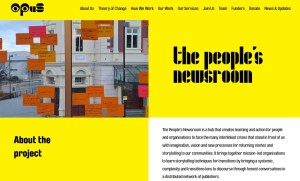 A central theme in the episode is dissatisfaction with the dominant media model. Megan and Debs suggest that much conventional journalism still operates through extraction. Stories are taken, packaged and sold back to the public, often without acknowledging the social relationships and lived knowledge from which those stories emerge. In contrast, the idea of a story commons begins from the recognition that storytelling is already a shared social practice. Journalism, in this view, should not simply harvest information. It should help people make sense of their lives together.
 This becomes especially relevant when the discussion turns to the growing tendency of institutions to communicate through social video, influencers and platform-led messaging. The issue, however, is not simply whether government or public bodies are using the right channels. The deeper question is why trust has eroded in the first place. If institutions are struggling to reach people, the answer may not be to imitate the style of social media more efficiently. It may be to ask whether they have stopped listening well, and whether communication has become too managerial, too centralised and too detached from everyday experience.
What audiences often value is not polish alone, but authenticity, accountability and a sense that communication is grounded in actual human experience. That is where the People’s Newsroom offers a useful challenge. Rather than presenting a fixed newsroom template, it points towards a process of finding people and organisations who are already doing meaningful work in their communities, and learning from them collectively. Some of these groups would not define themselves as newsrooms at all. They may be arts organisations, neighbourhood initiatives or local civic groups. What matters is that they are already building trust, sharing stories and helping people stay informed and connected.
One of the most important ideas in the episode is that the process is itself part of the outcome. That shifts attention away from the finished article, report or video as the only measure of value. Instead, the way people gather, listen, contribute and negotiate meaning becomes part of the journalistic act. This is a significant challenge to media systems that reward speed, scale and emotional reaction. It suggests that trustworthy media may depend less on industrial efficiency and more on social depth.
Debs extends this argument through the language of the commons. A commons is not simply a shared asset. It is a set of practices through which people steward something together. The comparison with language is useful. Nobody owns language, yet people learn to use it through participation, repetition, experimentation and shared norms. In the same way, a media commons would rely on lived practice, not just formal rules. It would depend on habits of care, mutual responsibility and collective accountability.
This also raises practical questions about standards, ethics and regulation. The episode does not suggest that all storytelling should be informal or unstructured. Rather, it points towards the need for layered accountability, where local autonomy is supported by shared codes and backstop mechanisms. That matters at a time when many creators and communicators are working independently, often with limited institutional backing but significant public responsibility.
Another strong thread in the conversation is the role of place. The discussion argues that too much contemporary media either leaves people stranded in the noise of platform culture or pulls attention upwards towards large, centralised institutions, while neglecting the middle ground of trusted, local, independent media. Place matters because it is where relationships are built and where stories gain meaning. At the same time, place cannot be understood in isolation. Local experience is always shaped by wider economic, ecological and political forces. A grounded media practice therefore has to be rooted in place while remaining aware of wider interdependence.
What this episode offers, above all, is not a finished blueprint but a change of orientation. It invites us to think about media not only as content production, nor simply as institutional reform, but as a social practice of connection, interpretation and stewardship. In an age of collapsing trust, distracted attention and centralised platform power, the question may not be how to restore old media systems. It may be how to cultivate new forms of shared sense-making that are accountable to people, grounded in lived realities, and capable of sustaining a more regenerative civic future.
That is the promise of a story commons. It is not a slogan or a branding exercise. It is a practical challenge to think again about how stories are gathered, who gets to tell them, and what kind of public life they help to create.