

What should a radio station sound like? Does it have to follow an established format, play recognisable music, feature polished presenters and compete for audience attention? Or can radio become something different: a space for artistic experimentation, collective imagination and creative participation, where the process of making sound is as important as the resulting programme?
These are some of the questions we are exploring through Radio Lear – Leicester Emergent Arts Radio, a volunteer-driven community radio service broadcasting on DAB+ in Leicester, Loughborough and the surrounding area, as well as online.
Radio Lear is not intended to replicate established music radio formats. It is an opportunity to reconsider what radio might become when it is treated as an artistic medium in its own right, rather than simply a delivery system for music, entertainment and information.
The ambition is to develop an accessible platform for sound arts innovation, experimental music, creative writing, field recording, improvised performance, storytelling and reflective cultural programming. Just as importantly, Radio Lear is an experiment in how people can come together to make media without having to conform to conventional expectations of professional broadcasting.
For me, this is directly connected to the work of Decentered Media and a longstanding commitment to diversifying media supply, encouraging civic participation and establishing alternative models of media production that can be sustained independently of large commercial organisations.
Radio as an Artistic Medium
Much of contemporary radio is organised around the concept of the format. Programmes and stations are designed to meet predefined audience expectations, often using familiar patterns of presentation, musical selection, scheduling and branding.
There are good practical reasons for these conventions. They help broadcasters establish recognisable services and build relationships with their listeners. However, they also tend to narrow our expectations of what radio can be.
Experimental sound art frequently works in the opposite direction. Rather than beginning with a predetermined audience response, it explores uncertainty, improvisation, duration, silence, repetition, texture and the relationship between sound and its surroundings.
A recording of a room, a passing conversation, an improvised collection of electronic noises or the sound of objects being handled can become material for artistic exploration.
Radio allows these experiences to be shared beyond their original setting. The act of broadcasting changes the context in which they are heard, creating different relationships between the listener, the material and the environment.
This is not a new idea. Artists including Delia Derbyshire, Pauline Oliveros, John Cage and Laurie Anderson have demonstrated how sound technologies, listening practices and experimental composition can expand the possibilities of artistic expression.
Radio Lear draws inspiration from these traditions without attempting to reproduce them. The intention is to develop contemporary forms of creative practice that are rooted in Leicester, open to experimentation and accessible to people who may not identify themselves as professional artists or broadcasters.
The station’s original artistic direction, developed by Max Sturm, draws upon metamodern perspectives that encourage movement between apparently contradictory ways of understanding the world. Radio Lear consequently seeks to accommodate the relationship between technology and imagination, structure and improvisation, individual expression and collective participation.
Sound Assembly – Learning Through Participation
One of the most interesting developments at Radio Lear is the Sound Assembly programme, a series of informal, participatory gatherings taking place at the Braunstone Gate Arches on Bede Street in Leicester.
The principle is straightforward. People come together with objects, instruments, electronic devices, recordings, voices, ideas and stories. They are invited to experiment with sound, listen to one another and discover what emerges from the interaction.
There is no requirement to perform a finished composition, follow a musical score or produce something that would normally be recognised as a radio programme.
Instead, the creative activity develops through the relationships between participants, the material they bring and the acoustic characteristics of the space.
These sessions are recorded and subsequently broadcast on Radio Lear, with podcast versions allowing the material to be experienced again.
During the Sound Assembly held on 30th September, for example, two improvised sound pieces emerged without a central conductor or predetermined structure. The resulting broadcast retained conversations and exchanges between participants, recognising that these interactions were part of the creative process rather than unwanted interruptions.
This is an important distinction. Conventional broadcasting usually treats production as a process of refining material into a finished programme. Uncertainty, hesitation, mistakes and technical imperfections are often removed.
In Sound Assembly, these moments may be precisely where something interesting happens. The process is not simply a rehearsal for an eventual performance. It is itself an artistic encounter.
Participants learn by doing, listening, responding and reflecting. Their involvement does not depend on achieving a prescribed technical standard, and the resulting recordings do not have to conform to commercial expectations of entertainment.
The next Sound Assembly, planned for Wednesday 28th October, will explore Spooky Sounds and Stories, drawing upon ghost stories, folklore and the imaginative possibilities of sound associated with Leicester and the Midlands. Recordings will contribute to a special Halloween broadcast on Saturday 31st October from 9pm.
These activities demonstrate how an ordinary community space can become a temporary sound laboratory, while a small radio station can extend the experience to a wider audience.
Artificial Intelligence as a Creative and Practical Resource
One of the significant practical challenges facing a small experimental radio station is the cost of sustaining continuous broadcasting. Conventional music radio depends heavily on commercially released recordings. Using these recordings involves copyright permissions, licensing arrangements and associated costs, which can be substantial for a small, volunteer-led organisation.
Radio Lear is exploring an alternative approach. By concentrating on original sound recordings, contributions from participating artists, appropriately licensed material and AI-assisted or AI-generated music and audio, it is possible to develop a programming service that is less dependent on the conventional commercial music catalogue.
Artificial intelligence is particularly useful in this context because it allows experimental material to be created, adapted and combined without requiring access to expensive studios, large production teams or extensive libraries of commercially licensed recordings.
It can help create sonic textures, musical sketches, imaginary soundscapes and unusual combinations of styles. It can also support programme planning, research, writing and production.
However, AI is not being treated as a substitute for human creativity or participation.
Its value lies in extending the range of tools that participants can use and reducing some of the financial and technical barriers to experimentation.
There are important qualifications. AI-generated content is not automatically free of copyright restrictions or licensing obligations. The provenance of material, the conditions imposed by AI providers, performers’ rights and the rights associated with incorporated recordings must still be considered. Radio Lear’s approach is therefore to prioritise original and appropriately authorised material, rather than assume that AI removes every rights-management requirement.
This distinction matters because the purpose is not to replace musicians, composers or sound artists with inexpensive automated production. It is to establish a practical environment in which human artistic experimentation can take place without the station’s limited resources being absorbed by the costs of conventional music programming.
The wider creative question is equally interesting. If AI makes it easier to produce sounds, compositions and unfamiliar combinations of musical material, how might this alter the relationship between creativity, authorship, listening and participation?
Rather than treating this as a question that can be answered through abstract debate alone, Radio Lear offers an opportunity to examine these issues through practical experimentation.
Beyond the Conventional Radio Format
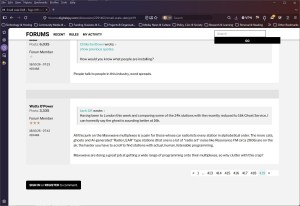
Radio Lear is deliberately not trying to sound like a mainstream music station. This can create misunderstandings, especially when the service is encountered by listeners who are accustomed to radio stations offering familiar musical genres, regular presenters and predictable programme structures.
The broader small-scale DAB sector has opened up opportunities for an increasingly diverse range of services. Some are commercially oriented, some serve particular communities of identity or interest, while others provide specialist programming that would struggle to find space on established broadcasting platforms.
There is also criticism of experimental stations, AI-generated material and services that do not correspond to conventional understandings of what constitutes professional radio.
These criticisms are worth taking seriously, particularly when they raise questions about technical quality, listener accessibility, originality and the responsible use of broadcasting capacity. However, the presence of unconventional services should not automatically be regarded as a weakness of the broadcasting system.
A diverse media environment needs room for different kinds of cultural activity, including services that attract relatively small audiences but provide opportunities for distinctive forms of expression. This is one of the reasons why I am particularly interested in the development of Radio Lear.
The measure of success for a participatory arts radio station cannot simply be whether it sounds like an established broadcaster or attracts the largest possible audience.
It must also include what people can accomplish through their participation, the skills they develop, the relationships they establish, and the creative possibilities that become available because the platform exists.
A sound artist who finds an opportunity to experiment with broadcasting, a writer who discovers a new way to present a story, or a participant who develops confidence through collective improvisation may gain something of lasting significance, even when the resulting programme reaches a relatively modest audience.
That does not mean abandoning editorial responsibility or technical standards. Rather, it requires a different understanding of quality, based on the aims and circumstances of the artistic practice being undertaken.
Participation, Social Gain and Media Pluralism
My interest in Radio Lear is informed by more than twenty-five years of teaching, researching and developing community media projects. A central question throughout this work has been how people become involved in making media, what motivates them to participate, and how these experiences contribute to wider forms of community development.
My doctoral research, Participation and Advocacy in Community Media, examined the everyday activities of community media volunteers and advocates in Leicester. One of its conclusions was that participation cannot be understood simply as a means of producing media content. It is also a social process through which people negotiate relationships, develop capabilities, establish shared understandings and discover new possibilities for action.
This perspective has continued to inform the work of Decentered Media. In the 2019 report When the Goal Is Not to Scale, written with Clare Cook and Jennifer Jones for Internews Europe, we argued for a greater recognition of the social and economic value of locally rooted community and civic media.
The argument was not that every small media project should attempt to become a larger organisation. Rather, it was that different models of ownership, participation, social purpose and economic sustainability should be recognised as legitimate forms of media development. Radio Lear provides an opportunity to test these principles in practice.
Its activities connect with what I have increasingly come to describe as Foundational Media: the everyday communication capabilities, facilities, relationships and organisations that enable people to make and share media for themselves.
From this perspective, the value of a broadcasting service lies not only in the programmes it distributes, but also in the opportunities it provides for people to acquire skills, develop confidence, participate in cultural life and experiment with creative practices.
A healthy media ecology requires independent services that can develop on their own terms, rather than being compelled to reproduce the working methods of established commercial and institutional broadcasters.
This is what media pluralism should mean in practice: not simply more channels distributing similar content, but greater diversity in who can make media, how it is produced, the purposes it serves and the people who can participate.
Establishing a Sustainable Arts Radio Service
The challenge for Radio Lear is to turn these ideas into a sustainable organisational model. The station is managed on a not-for-private-profit basis by Community Sounds and Stories CIC and holds Ofcom licences to broadcast on DAB+ in Leicester and Loughborough. Importantly, Radio Lear has received support from the Ofcom Community Radio Fund.
In February 2026, Ofcom confirmed an award of £17,000 to Community Sounds and Stories CIC for a Business Development Manager supporting Radio Lear. The Fund is allocated by the Department for Culture, Media and Sport and administered by Ofcom.
This support provides an opportunity to examine the practical requirements of establishing a resilient and sustainable participatory arts broadcasting service.
The business development work is intended to identify opportunities for collaboration, develop relationships with arts and community organisations, explore suitable income sources and establish the operational arrangements necessary to maintain the station.
This is not simply about securing enough money to continue broadcasting. It is about developing a model of community arts media that can combine creative independence, accessible participation and realistic financial management.
Potential avenues include collaborative arts projects, educational activities, workshops, commissioned sound works, cultural partnerships, voluntary contributions and other forms of appropriate support. There is an important balance to maintain.
If Radio Lear becomes overly dependent on conventional commercial broadcasting income, there is a risk that its distinctive artistic purpose will be displaced by the pressure to deliver familiar, commercially attractive programming.
Conversely, relying indefinitely on volunteers and occasional grants without developing an operationally credible model is unlikely to provide a stable foundation for artistic participation. The task is to establish a workable relationship between these different requirements.
An arts radio station needs dependable technical infrastructure, reliable transmission, editorial accountability, safeguarding, accessible opportunities to contribute, appropriate rights management and sound financial governance. These responsibilities are not separate from its artistic ambitions. They provide the conditions within which creative experimentation can continue.
A Different Approach to Creative Development
The longer-term ambition is to establish Radio Lear as a platform through which sound artists, musicians, writers, researchers, community organisations and interested participants can experiment with sound and broadcasting. This does not require everyone to share the same artistic outlook or work towards a predetermined creative outcome.
Indeed, the value of an emergent arts approach is that unexpected relationships and possibilities can develop through participation. A project might begin with a field recording from a Leicester street, an improvised exchange between musicians, an exploration of local folklore or an experiment with generative audio. It might develop into a broadcast, a collaborative performance, a podcast, an installation or an entirely different form of creative activity.
What matters is that the opportunity exists for people to test ideas together. The metamodern perspective that informs Radio Lear is useful here because it encourages us to move between different forms of understanding without assuming that we must resolve every contradiction in advance.
We can value tradition while experimenting with new technologies. We can take artistic practice seriously without insisting that every contribution must be professionally polished. We can appreciate individual creativity while recognising that meaningful work often emerges through collaboration.
We can also use digital and AI technologies without assuming that technological innovation, on its own, represents cultural progress. For me, these are practical questions about how we organise opportunities for people to make things together, rather than abstract questions about the future of the creative industries.
Making Room for Different Kinds of Radio
Radio Lear remains a modest undertaking, and there is much to learn about how its participatory model can develop. It does not claim to have discovered a definitive alternative to established forms of radio. Nor is its purpose to suggest that conventional broadcasting, popular music or professional production are somehow less valuable than experimental arts practice.
The point is that different approaches should be able to coexist.
Small-scale DAB broadcasting has created opportunities for local and independent media providers to establish services that would previously have been difficult to sustain. We should make the most of those opportunities by encouraging genuine diversity of purpose, ownership, participation and content.
For Radio Lear, success will mean gradually establishing a stable, accessible and welcoming platform where people can experiment with sound, develop creative relationships and discover new ways of using radio. It will mean learning from what works, recognising what does not, and remaining willing to change the approach as new possibilities emerge.
Most importantly, it will mean retaining the principle that radio is something people can make together, rather than simply something they are expected to consume.
That is why I am keen to continue developing Radio Lear alongside the wider work of Decentered Media. It offers a practical way of testing how foundational, participatory and socially accountable media can contribute to a more pluralistic and creative broadcasting environment.
The invitation is open to artists, sound makers, writers, researchers, community groups and anyone interested in experimenting with sound and listening. You do not need to arrive with a finished programme or a professional broadcasting background. Curiosity, a willingness to listen and an interest in discovering what might emerge are useful starting points.
Radio Lear is an experiment in what becomes possible when we make space for different voices, different sounds and different ways of working. And that, perhaps, is one of the most valuable purposes an independent community radio station can serve.
Listen, explore and contribute: https://radiolear.uk