
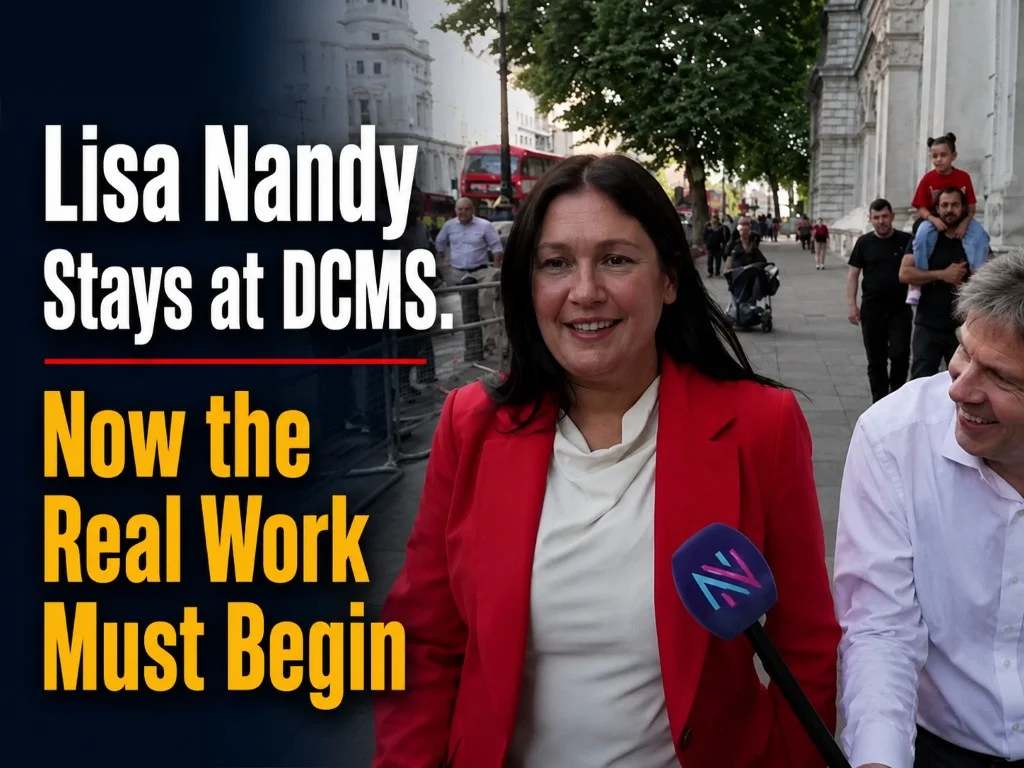
Lisa Nandy MP’s continuation as Secretary of State for Digital, Culture, Media and Sport offers an opportunity for continuity. It also removes a convenient excuse. Nandy has now had sufficient time to understand the institutional landscape, identify the interests blocking reform, and decide whether she intends merely to manage the existing media system or change it. The next phase must be considerably more ambitious.
I’ve sent this letter to Lisa Nandy.
The Missing Middle of British Media
Britain’s media system has developed an increasingly damaging gap between national institutions and global digital platforms.
At one end are the BBC, the major commercial broadcasters, established newspaper groups and a small number of powerful production and distribution businesses. At the other are multinational technology companies whose platforms increasingly determine how people find news, encounter public debate and communicate with one another. Between them should be a diverse and sustainable layer of local, independent, cooperative, community and civic media.
Instead, this middle layer has been allowed to weaken.
 The consequences extend beyond the loss of individual publications, radio stations or reporting jobs. When places lose their means of representing themselves, they also lose part of the infrastructure through which local identity, accountability and common purpose are maintained.
Community media should not be viewed as a marginal supplement to “real” media. It can provide a practical means through which citizens tell their own stories, scrutinise local institutions, develop communication skills and take part in public life.
The central policy question is therefore not merely how government can preserve existing media organisations. It is how Britain can build a healthier media ecology in which people possess meaningful opportunities to communicate, organise and represent themselves.
Media Infrastructure Is Civic Infrastructure
Nandy has frequently spoken about place, belonging, participation and the need to return power and responsibility to local areas. Media policy must now be brought into line with that principle.
Devolution cannot be confined to transport, skills, housing, investment zones and administrative structures. If citizens are expected to participate meaningfully in devolved government, they also need independent communication systems through which they can understand decisions, test claims, challenge authority and discuss competing priorities.
The development of stronger devolved government, including the growth agenda associated with Andy Burnham’s administration in Greater Manchester, illustrates the political direction in which this argument is moving.
Yet, economic devolution without communicative devolution remains incomplete.
Mayors, combined authorities and councils may acquire more responsibilities, but citizens will not necessarily gain more voice. Powerful local institutions can become every bit as remote, managerial and resistant to scrutiny as national ones.
A devolved state therefore needs a devolved media ecology.
A Civic Compact for Media
Nandy should establish an alliance of alternative media providers capable of informing national media policy and supporting civic participation in every region and nation of the United Kingdom.
This alliance should include community radio stations, independent local publishers, cooperative news organisations, civic media networks, community television projects, local podcasters, specialist publications, independent production groups and participatory digital platforms.
It should not be assembled as another temporary consultation panel dominated by established professional organisations. Nor should community media representatives be invited merely to add diversity to discussions whose assumptions and conclusions have already been determined. The alliance must have a substantive policy role.
It should advise government on funding, regulation, public-interest commissioning, skills, digital distribution, local accountability and the development of shared civic infrastructure. It should also help create practical relationships between local government, civil society, universities, public services and independent media providers.
The principle should resemble the emerging civic compact: government does not presume that public communication must always be delivered from the centre, but recognises the capacity of citizens and independent organisations to represent themselves. This requires investment in organisations and networks, not simply short-term content grants.
The aim should not be to make every organisation scale into a national provider. It should be to create the conditions in which plural, locally accountable services can become viable and resilient on their own terms.
Nandy Must Challenge Incumbent Power
The greatest obstacle is unlikely to be a shortage of ideas. It will be the power of incumbent organisations to define the limits of acceptable reform.
Legacy media institutions often present themselves as the natural custodians of public value. Their historical role is important, but longevity should not confer a permanent right to dominate policy discussions, funding systems or distribution arrangements.
Established broadcasters and publishers have considerable access to ministers, officials and regulators. Smaller providers generally do not. This creates a circular policy process in which government consults the organisations already benefiting from the system, receives recommendations that preserve their position, and then presents institutional continuity as evidence of the public interest.
Nandy needs to be more active and assertive in challenging this pattern.
Measures intended to protect trusted news and public service media may have legitimate objectives, but they also raise important questions:
- Who decides which providers are trusted?
- Will prominence measures entrench the visibility of existing broadcasters and publishers?
- What opportunities will be created for independent, community and civic providers?
- Will the new system diversify public communication, or make established institutions even harder to challenge?
A policy designed to support trustworthy media must not become a mechanism for protecting incumbency.
The BBC Must Serve Citizens, Not Merely Audiences
The BBC must also face more exacting scrutiny. Its national reach, public funding and cultural significance give it responsibilities that go beyond the production of popular programmes. The Corporation should strengthen democratic participation, support media plurality and contribute to the communications capacity of the country.
Charter Renewal should therefore ask whether the BBC is sufficiently responsive to citizens as citizens, rather than treating them principally as audiences, users or licence-fee payers. The BBC should be required to demonstrate how it supports independent local production, community participation, open civic dialogue and the circulation of knowledge beyond its own institutional boundaries.
That might include shared facilities, training partnerships, open archives, local commissioning, technical support and more systematic collaboration with community and civic providers. The aim should not be to weaken public service media. It should be to distribute its benefits more widely.
Public service cannot be measured solely by what a large institution transmits. It must also be assessed by the capabilities, relationships and opportunities it helps to create.
Ofcom Has Become Too Broad
There is also a strong case for reviewing Ofcom’s institutional structure. Ofcom now regulates telecommunications, television, radio, on-demand services, spectrum, postal services and significant aspects of online safety. Each of these areas involves distinct technologies, markets, public interests and regulatory problems.
This breadth may appear administratively efficient, but it risks spreading attention too thinly and encouraging a generic regulatory culture that is insufficiently responsive to the particular needs of different sectors.
Broadcasting and civic media require detailed knowledge of editorial responsibility, plurality, participation, local provision and cultural value. Telecommunications regulation centres on infrastructure, markets, access and consumer protection. Online safety involves platform systems, risk management and fundamental questions concerning expression, privacy and harm.
These responsibilities should not automatically remain inside one expanding super-regulator. Breaking up Ofcom, or creating substantially more autonomous regulatory divisions with separate statutory objectives and leadership, should be considered seriously. The objective would be clearer accountability and stronger specialist focus, not institutional disruption for its own sake.
DCMS Must Remain on X
Nandy and her department must also remain present on X. The platform is frequently hostile, argumentative and unpleasant. It is also one of the places where journalists, campaigners, policy specialists, politicians and members of the public continue to challenge government in real time.
Ministers do not have to endorse the conduct of a platform in order to maintain a public presence on it. Leaving difficult spaces for perceived safer waters may protect political messaging, but it does little for democratic accountability. It can look less like principled leadership and more like flouncing away from criticism.
Nandy should meet her critics head-on. That means answering substantive questions, correcting false claims, publishing evidence and explaining difficult decisions. It does not mean responding to every insult or participating in every manufactured controversy.
A Secretary of State responsible for media and communications should demonstrate confidence in open, plural and sometimes uncomfortable public debate.
Two Years Have Been Wasted
There is now a significant amount of work to recover. The first two years have produced consultations, announcements and broad statements of intent, but little that has materially changed the position of local, independent, community and civic media.
- The middle of the media system remains weak.
- Local accountability continues to decline.
- Community media remains poorly supported.
- Public policy is still shaped disproportionately by incumbent institutions.
- Ofcom’s responsibilities continue to expand.
- The BBC’s relationship with citizens remains insufficiently reciprocal.
- Two years have been wasted, and there is much to catch up on.
Nandy now has the opportunity to change course. She should use her continuation at DCMS to build a serious alliance for media reform: one that combines public service principles with local participation, institutional scrutiny, devolved power and the right of citizens to represent themselves.
The real work must begin.