
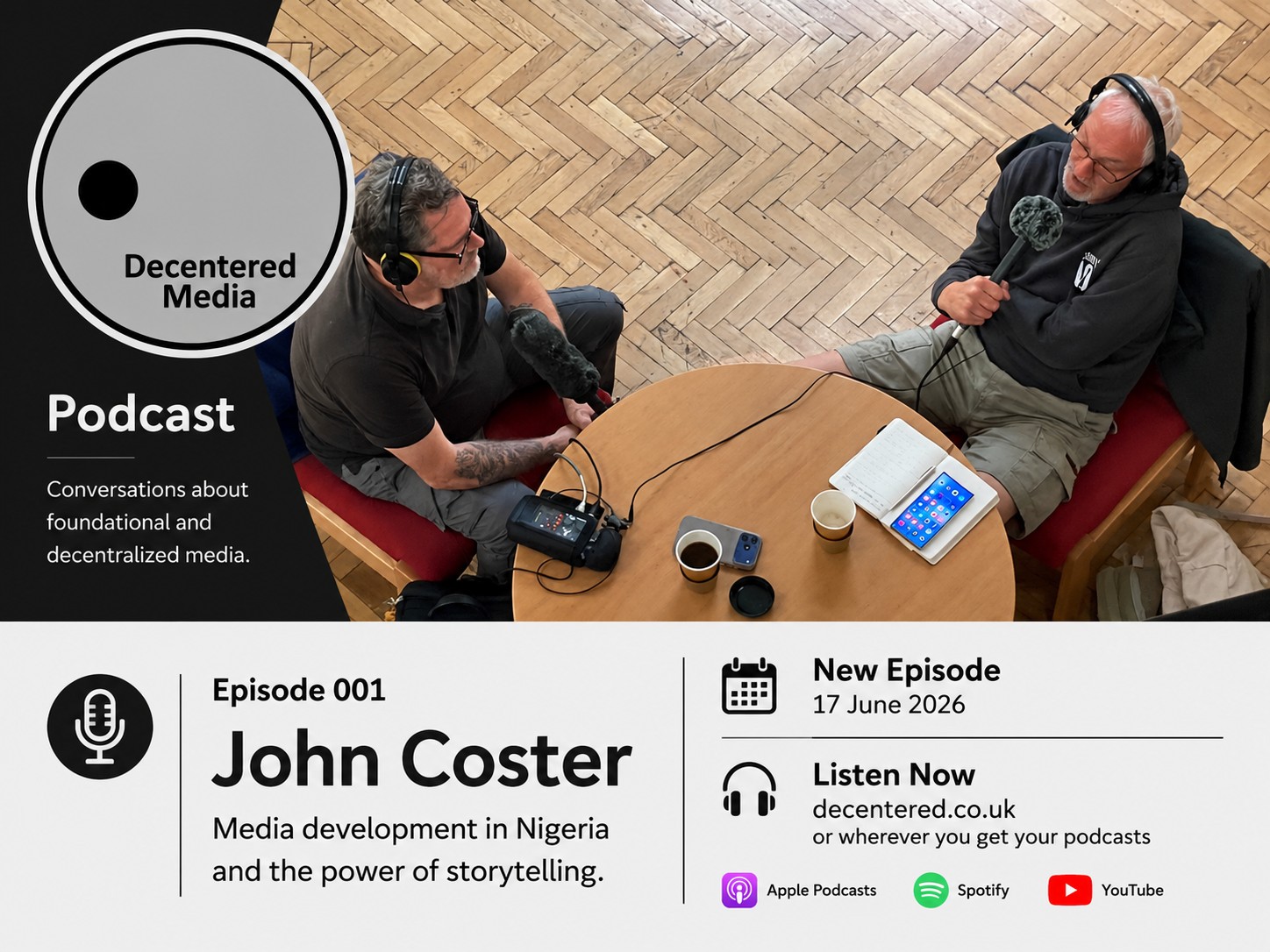
What happens when we stop treating media as a production process and start thinking about it as a relationship-building practice?
That question sits at the centre of a recent Decentered Media conversation with community media practitioner John Coster. Reflecting on his latest visit to Nigeria, John describes his work supporting the development of S24 Television, an emerging media organisation that is seeking to build a different approach to journalism, storytelling and public engagement.
At first glance, the discussion appears to be about international media development. Yet the themes raised are equally relevant to the United Kingdom and to anyone interested in the future of local, community and civic media.
Over the course of four weeks in northern Nigeria, John worked with journalists, producers and media managers to develop new approaches to reporting. Rather than focusing solely on newsroom processes, production targets or audience metrics, the emphasis was placed on helping people reconnect with the communities they serve.
One example stands out. Instead of writing stories based on press releases or distant events, journalists were encouraged to go into their communities, speak to market traders, food vendors and residents, and understand how wider economic or political decisions affect everyday life. The goal was not simply to report what happened, but to understand why it matters and who is affected.
This approach reflects a long-standing tradition within community media. The most valuable stories often emerge through conversation, trust and participation rather than through institutional routines. Media becomes less about broadcasting information and more about facilitating understanding.
The discussion repeatedly returns to the legacy of Citizens’ Eye in Leicester. For John, the lessons learned through community reporting projects remain as relevant today as they were when digital participation first became widely accessible. The tools have changed, but the fundamental principles remain the same. People want to tell stories that matter to them. They want to see their experiences reflected. They want opportunities to contribute rather than simply consume.
One of the most striking observations concerns confidence and permission. Many people possess the skills, knowledge and experiences needed to tell meaningful stories, yet often feel that they lack the authority to do so. Professional media institutions have historically acted as gatekeepers, determining which voices are considered legitimate and which are not.
The growth of digital platforms has altered that landscape. Smartphones, podcasts, community websites and social media have given people unprecedented opportunities to communicate. Yet the discussion asks whether attitudes have kept pace with technological change. Why do so many people still believe that meaningful storytelling must be authorised by established institutions? Why do community-generated stories continue to be viewed as secondary to professionally produced content?
The conversation suggests that these assumptions are becoming increasingly difficult to justify. Community reporters, independent creators and local storytellers now have the ability to reach audiences directly. They can investigate issues, document experiences and build networks of trust that often operate outside traditional media structures.
The discussion also touches on broader questions about fear, identity and social cohesion. Rather than dismissing concerns that people hold, John argues that media should help us understand them. Asking “What are you afraid of?” may be an uncomfortable question, but it can often reveal concerns that are otherwise ignored or misrepresented.
This does not mean accepting every claim uncritically. Rather, it means recognising that meaningful communication begins by listening. If people feel unheard, they will seek alternative channels through which to express themselves. Community media offers one way of creating spaces where these conversations can take place constructively.
Another theme concerns intercultural learning. John’s experiences in Nigeria challenged many assumptions about identity, belonging and cultural exchange. By participating in local customs, engaging with communities and learning from different traditions, he discovered that many anxieties commonly found in British public discourse are often less significant in practice than they appear in theory.
Travel, storytelling and conversation all serve a similar purpose. They help us see our own communities through different eyes. They encourage us to question assumptions and recognise that many social challenges are shared across different places and cultures.
For Decentered Media, these questions sit at the heart of the idea of foundational media. Media should not be understood solely as an industry, a technology or a marketplace. It is also a civic resource that helps people make sense of their lives, understand one another and participate in public life.
As media systems become increasingly automated, data-driven and platform-dependent, there is a risk that the human dimension of communication is overlooked. The challenge is not simply to produce more content. The challenge is to create the conditions in which people can share experiences, build trust and develop a deeper understanding of the communities they belong to.
This conversation offers a reminder that some of the most important innovations in media are not technological. They begin with a simple question, a shared story, and a willingness to listen.