

The value of community media is often most apparent in relatively ordinary situations. People come together to share information about their work, residents ask questions, and conversations develop that might otherwise never take place. There may be little that is conventionally newsworthy about these encounters, but they can reveal a great deal about how communities function and how public services connect with the people they are intended to support.
This was the experience of Soar Sound, one of Leicester’s community radio stations, when we attended the Community Assessment Day at Braunstone Leisure Centre in October 2026. The event brought together health professionals, voluntary organisations, public services and residents to discuss health, wellbeing and physical activity.
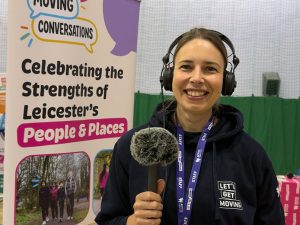 Working alongside community reporters Helen Pettman and Karolina, we recorded conversations with exhibitors and visitors. These were subsequently edited into two podcast episodes, allowing listeners to hear about the services and projects being discussed.
Listening back to these recordings raises questions about the role of community media in public engagement, particularly the need to overcome hesitancy towards independent broadcasting and establish relationships based on relevance, trust and local accountability.
Extending Participation Beyond the Event
One limitation of community engagement events is that their immediate benefits are largely restricted to those who can attend. A health information day may bring together numerous organisations and offer opportunities for valuable conversations, but many residents will be unable to participate.
Some will be working, others will have caring responsibilities, mobility difficulties or limited access to transport. Many will simply be unaware that the event is taking place, despite potentially benefiting from the information being shared.
 Community broadcasting offers a practical way of extending these encounters beyond their original location and time. By recording conversations with service providers and distributing them through radio and podcasts, Soar Sound enables people to hear about local health projects without needing to attend in person.
This is particularly relevant in a city like Leicester, where communities have different experiences of public services, communication and civic participation. A conversation heard on the radio may prompt someone to seek advice, ask their GP about a referral, contact a local organisation or share information with a neighbour.
The value lies not simply in distributing information more widely, but in presenting it through conversations that people can understand and relate to. Hearing a practitioner explain their work in their own words can make an unfamiliar service seem more approachable and relevant.
Hearing About the Work Taking Place Across Leicester
The range of projects represented at the Braunstone Leisure Centre was considerable. NHS staff discussed falls prevention, pelvic health, talking therapies, diabetes prevention and plans for lung cancer screening. Voluntary organisations explained their work supporting carers, helping people manage arthritis and providing advice on household energy costs.
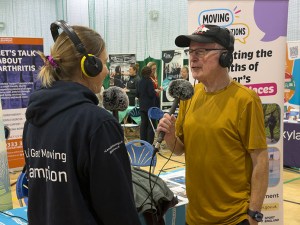 Leicester City Council’s public health team described activities encouraging residents to take up preventative health checks and become involved in gardening and other community initiatives. Wesley Hall Community Centre explained how its activities bring people together through practical support, music, wellbeing sessions and informal opportunities for social contact.
Karolina, representing the Moving Conversation initiative, spoke with residents about how they already incorporate movement into their everyday lives and what might encourage them to become more active. These encounters demonstrated that physical activity is not restricted to organised sport or exercise classes, but includes walking, socialising and everyday activities.
Several conversations were particularly revealing because they addressed issues that people may find difficult to discuss. A pelvic health physiotherapist explained how bladder and bowel problems can affect confidence and participation in everyday life, while a falls prevention specialist described how the fear of falling can lead people to withdraw from activities, lose strength and become increasingly isolated.
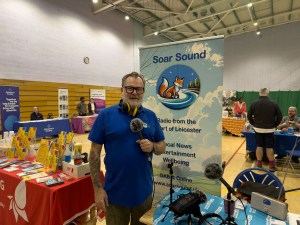 The representative discussing lung cancer screening explained why early detection matters and how mobile screening facilities could make the service more accessible. These discussions were not simply promotional descriptions of institutional programmes, but explanations by practitioners of what they do, why it matters and how people might benefit.
That is precisely the kind of information that community broadcasting is well placed to communicate. It connects practical knowledge with the everyday concerns of listeners who may not otherwise encounter these services.
Why Are Some Organisations Reluctant to Talk?
Most people attending the event were enthusiastic about speaking with Soar Sound and recording conversations. They welcomed the opportunity to explain their work and seemed pleased that their activities could reach an audience beyond the leisure centre.
However, a number of exhibitors were more hesitant. Some appeared uncertain about whether they were authorised to speak, while others seemed uncomfortable with the possibility of being recorded for broadcast.
It would be unfair to assume that every instance of reluctance had the same explanation. Some people may simply be unfamiliar with radio interviews or uncertain about their ability to explain their work clearly, but the experience raises a broader question about the relationship between public organisations and independent media.
Why should people working on projects intended to benefit the public feel uncomfortable talking about them publicly? Part of the answer may lie in the wider decline of trust in media.
Sensationalism, adversarial reporting, political polarisation and concerns about statements being taken out of context have contributed to an environment in which media engagement can be regarded as a risk rather than an opportunity. Those concerns are not without foundation, and community media practitioners must recognise that trust cannot simply be demanded.
Trust must be established through responsible editorial practice, accuracy, fairness and transparent relationships with contributors. However, if distrust becomes an automatic reason for avoiding public conversations, the consequences can be damaging, with residents losing opportunities to learn about services and organisations missing opportunities to demonstrate the value of their work.
When Communications Management Restricts Engagement
Another potential barrier is the institutional culture created by marketing, communications and public relations departments. Within public authorities and larger organisations, there are legitimate reasons for establishing clear procedures about media engagement, particularly where confidentiality, safeguarding, professional responsibilities and the accuracy of public statements are concerned.
However, these procedures can sometimes become unnecessarily restrictive. Rather than preparing colleagues to communicate confidently and responsibly with the public, communications departments may concentrate on controlling messages and limiting who is authorised to speak.
The result can be an organisational culture in which employees hesitate before accepting an ordinary interview about the services they provide. This approach risks confusing the management of institutional reputation with the wider responsibility to engage with the public.
There is an important distinction between speaking on behalf of an organisation about a sensitive policy decision and explaining how a community health project works. A physiotherapist describing a preventative health programme, or a community worker discussing activities available to local residents, should normally be capable of doing so without navigating a complicated process of communications approval.
Marketing and public relations departments could make a much more constructive contribution by equipping colleagues with the confidence and skills to participate in these discussions. Practical media training, clear guidance and an understanding of editorial independence would help staff recognise opportunities to engage with residents while maintaining appropriate professional boundaries.
Public communication should be seen as an everyday responsibility, not simply a specialist function controlled by a central department. Organisations delivering publicly funded services should actively encourage their staff to explain the work they undertake and the opportunities available to residents.
Community Reporting Is Not Institutional Publicity
There is also a responsibility on community media organisations to demonstrate how their approach differs from conventional publicity. Soar Sound is an Ofcom-licensed community radio service with editorial responsibilities, rather than simply a platform for reproducing promotional statements supplied by public authorities or voluntary organisations.
Community reporting should allow practitioners to explain their work while creating opportunities for questions, clarification and discussion. At health fair, conversations about physical activity naturally moved towards the challenges created by transport, childcare, affordability and the quality of public spaces.
Discussions about preventative healthcare raised questions about confidence, personal circumstances and the difficulties people face when attempting to change everyday habits. These are matters that may not feature prominently in institutional publicity, but they are essential to understanding how services operate in practice.
Independent community media can therefore provide a useful space between public institutions and residents. Its purpose is not to manufacture confrontation or simply repeat official messages, but to encourage informed discussion, make local knowledge accessible and ensure that different experiences can be heard.
Learning to Listen
One of the most significant aspects of the Community Assessment Day was the participation of Karolina as a community reporter. Working alongside more experienced contributors, she approached residents, asked questions and encouraged them to reflect on their experiences of physical activity.
At the end of the day, when asked what she had learned about interviewing people for radio, her response was straightforward: the importance of listening. This observation captures something fundamental about participatory community media.
Community reporting is not merely a matter of operating recording equipment or producing material for distribution. It is a process through which people develop the confidence to approach others, ask questions and create opportunities for dialogue.
Listening also changes the relationship between the reporter and the contributor. Rather than attempting to extract a predetermined statement, the reporter creates space for people to explain what matters to them and to reflect on their own experiences.
For public organisations uncertain about engaging with independent media, experiencing this approach can help reduce anxiety. Trust develops when contributors see that their knowledge and experiences have been represented responsibly and that their participation has produced something useful for the wider community.
The Value of Positive Media Engagement
The day itself was intense. Moving between exhibitors, recording numerous interviews, responding to unfamiliar subjects and maintaining concentration over several hours required considerable energy, with the practical demands of recording sometimes dominating the immediate experience.
Yet listening back to the conversations reveals something that was less apparent during the event: the considerable amount of useful knowledge being shared and the enthusiasm of those involved in delivering local services. The recordings provide a picture of people working across Leicester to improve health, encourage activity, support independence and strengthen community relationships.
They also show what can be achieved through relatively straightforward community reporting. There is no need for elaborate production techniques or dramatic editorial framing when a microphone, a few informed questions and a willingness to listen can produce material that remains useful long after an event has finished.
This is not an argument for avoiding difficult questions or abandoning critical scrutiny. Rather, it suggests that media engagement can be constructive without becoming deferential, and independent without being unnecessarily adversarial.
Building Leicester’s Community Media Infrastructure
For Soar Sound, the experience reinforces an important part of its developing mission. The station is working to overcome reluctance towards community broadcasting by demonstrating the practical benefits of participation and developing relationships with public authorities, health providers and voluntary organisations.
This means making the sharing of information through community radio a familiar and routine activity. It also means supporting people who may not previously have considered speaking on the radio, helping them understand what participation involves and giving them confidence in the editorial process.
Over time, the aim is to establish a culture in which organisations actively seek opportunities to explain their work through independent community media. Such opportunities should be regarded as a normal part of public engagement rather than an additional risk or administrative burden.
The wider ambition is to make community reporting an established part of Leicester’s civic infrastructure. Health services, community groups, local authorities and residents all benefit when information circulates openly and people have opportunities to understand one another’s experiences.
Community broadcasting can help sustain those connections, particularly for residents who cannot attend events or who are not already connected to established organisational networks. Its distinctive contribution comes from combining accessibility with opportunities for explanation, questioning and participation.
The Community Assessment Day demonstrated that the potential already exists. The task is to build the relationships, confidence and organisational practices needed to make this approach more consistent.
For Decentered Media, this is an example of why community media should be understood as a foundational civic resource rather than a marginal form of local broadcasting. Its value is established through repeated, practical encounters that allow people to share knowledge, understand local services and participate in the life of their communities.
The challenge is to replace the assumption that media engagement is primarily something to control with an understanding that open communication is an essential part of public service. A positive media culture does not mean avoiding accountability or difficult conversations, but establishing conditions in which people are willing to participate because they recognise that their contributions will be treated seriously.
That requires relevance, trust and local accountability. These qualities cannot be manufactured through publicity campaigns alone, but have to be developed through relationships, repeated engagement and the practical demonstration that community media can make a difference.
Listening again to the conversations recorded at Braunstone suggests that this is not an abstract ambition. It is something that can be achieved, one conversation at a time.
This article reflects on Soar Sound’s two podcast episodes recorded at the Community Assessment Day at Braunstone Leisure Centre in October 2026, featuring conversations with residents, NHS professionals, voluntary organisations and community workers about health, wellbeing and participation in Leicester.