
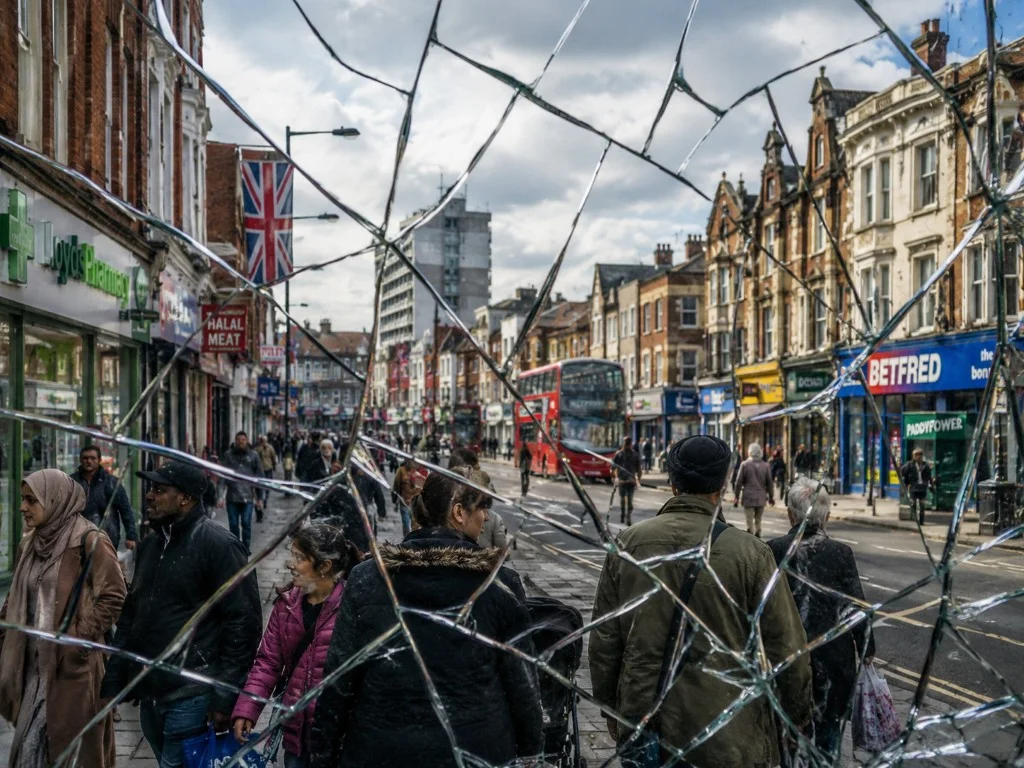
The publication of More in Common’s Britain Under Strain – The Broken Social Contract, Democratic Distrust and the Mainstreaming of Extremism has quickly become a focal point in the debate about social cohesion, democratic legitimacy and national identity in the UK.
As reported in the national press, the report draws on polling of more than 4,000 adults and highlights a series of disturbing findings. These include the claim that 61% of Britons believe the social contract has broken down, 55% believe diversity is eroding national identity, 42% believe British Muslims cannot integrate, and 33% support some form of “remigration”. The Guardian has also reported the contrast with polling of British Muslims, including the finding that 85% favour integration.
These are serious findings. They should not be dismissed because they are uncomfortable. Nor should they be accepted uncritically simply because they have attracted media attention.
The first task is to ask what the evidence tells us, what it does not tell us, and what additional forms of evidence are needed if policy is to move beyond alarm and into effective civic action.
Polling Can Identify Anxiety, But It Cannot Fully Explain It
Large-scale polling is a legitimate and useful form of evidence. It can help identify broad patterns of public opinion, track changes over time, and test whether particular views remain marginal or have become more widely held.
However, polling has limits.
It records what people say in response to specific questions at a particular moment. It does not, on its own, explain how those attitudes are formed, how strongly they are held, how they are moderated by everyday relationships, or how they might change through participation in shared civic life.
This matters because many of the terms at the centre of this debate are not neutral. “Integration”, “British values”, “diversity”, “national identity”, “social contract” and “extremism” are contested concepts. Different respondents may understand them in different ways. A person may express anxiety about national identity while also participating constructively in a local voluntary group with people from many backgrounds. Another may distrust national politics while continuing to trust local institutions, neighbours, faith groups, schools or community organisations.
The British Polling Council’s standards are relevant here. Its stated purpose is to ensure that enough information is disclosed about polling methods and results so that users of polling data can judge their reliability and validity. More in Common states that it publishes polling tables in accordance with British Polling Council rules, including methodology, weighted data and demographic breakdowns. The full value of the Britain Under Strain findings therefore depends on careful scrutiny of the questionnaire, fieldwork dates, weighting, sample recruitment, subgroup bases, question order and wording.
This is not a technical footnote. It is central to the public meaning of the report.
If a report is used to claim that particular views have become “mainstream”, then the process by which those views have been elicited must be open to public examination. Otherwise, there is a risk that polling becomes not only a measurement tool, but also a mechanism for legitimating and amplifying the attitudes it records.
This Report Sits Within a Longer Policy Lineage
The concerns raised by Britain Under Strain are not new. They sit within a long sequence of UK policy concern about cohesion, integration, social fragmentation and democratic resilience.
The Casey Review of 2016 examined opportunity and integration in isolated and deprived communities, and called for stronger action to bridge divides and bind communities together. The 2018 Integrated Communities Strategy Green Paper set out a vision of communities in which people from different backgrounds live, work, learn and socialise together, based on shared rights, responsibilities and opportunities.
More recently, the Khan Review on threats to social cohesion and democratic resilience warned that distrust in institutions, disinformation, intimidation and extremist exploitation are eroding democratic norms. It recommended a five-year Social Cohesion and Democratic Resilience Strategy and Action Plan.
There are also official data sources that complicate any single narrative of national breakdown. The Community Life Survey tracks neighbourhood belonging, community trust, civic engagement, social action, volunteering and charitable giving. Its 2024/25 publication covers precisely the kinds of everyday civic connection that are often missing from headline political debate.
The lesson is that Britain is not simply divided or cohesive. It is both, in different places, at different scales, and through different institutions.
This is why we need to map the civic infrastructure of trust rather than only measure the symptoms of distrust.
The Missing Question Is Where Democratic Habits Are Learned
If the report is right that democratic distrust is deepening, the next question is not simply what government should say in response. The question is where people learn the habits of democratic life.
- Where do people learn to listen to those with whom they disagree?
- Where do they encounter people outside their own social, ethnic, political or religious networks?
- Where do they practise negotiation, accountability and mutual responsibility?
- Where do they learn that public life is something they can take part in, rather than something done to them by remote institutions?
These are not only questions for counter-extremism policy. They are questions for civic infrastructure.
Libraries, local newspapers, community centres, schools, youth organisations, voluntary groups, faith groups, arts organisations, sports clubs, public service broadcasters, local authorities, universities and community media all have potential roles. But those roles should not be asserted as articles of faith. They should be mapped, examined and tested.
The Local Trust Community Needs Index is useful here because it recognises that social infrastructure, civic participation and local isolation can be measured as distinct dimensions of community need. This kind of mapping is essential if public policy is to avoid vague appeals to “community” while failing to identify the actual institutions and networks through which community life is sustained.
Community Media Is a Hypothesis to Test, Not a Magic Solution
Community, civic, independent and foundational media may have an important role to play in rebuilding civic trust, but that claim needs to be tested.
Internationally, community media is recognised as a contributor to media pluralism, freedom of expression, local content, cultural diversity, social inclusion and intercultural dialogue. UNESCO describes community media as independent, community-owned and community-managed media that forms an alternative to public and commercial media. The Council of Europe recognises community media as a source of local content, cultural and linguistic diversity, media pluralism, social inclusion and intercultural dialogue, and links it with critical and creative media literacy through active participation in content production.
This is a strong foundation, but it is not proof that community media automatically strengthens cohesion.
Community media can create opportunities for people to produce trustworthy local information, tell their own stories, interview one another, practise editorial judgement, learn communication skills and build relationships across social boundaries. In the right conditions, it can support bridging social capital rather than merely reinforcing closed identity networks.
But community media can also fail. It can become factional, poorly governed, captured by narrow interests, under-resourced, editorially weak or detached from wider civic accountability. Participation alone is not a guarantee of democratic resilience.
The serious policy claim is therefore narrower and stronger. Community and civic media should be treated as part of the civic infrastructure that may support democratic learning, local voice, accountable communication and social connection. Its role should be evaluated through a clear theory of change.
What forms of participation are expected to produce what outcomes? Which groups benefit? What conditions are necessary? What risks are present? What happens when projects lose funding, volunteers burn out, or local disputes become embedded? How can editorial independence be protected while civic partnership is encouraged?
These are practical questions, not rhetorical ones.
The Evaluation Framework Must Be Stronger
If community media is to be taken seriously as civic infrastructure, it must be evaluated properly. The Magenta Book, the UK government’s central guidance on evaluation, emphasises the need to assess policy design, implementation, outcomes, value for money and the mechanisms through which change is expected to occur.
This matters because social cohesion is not a simple output. It cannot be counted like audience reach, publication volume or social media impressions.
A serious evaluation framework would need to examine whether community media helps people develop confidence, trust, communication skills, local knowledge, civic agency and the capacity to deliberate across difference. It would need to test whether projects connect people across social boundaries or merely deepen existing networks. It would need to compare different models, such as community radio, civic journalism, neighbourhood newsletters, participatory podcasting, local forums, independent public-interest newsrooms and hybrid civic media hubs.
It would also need to ask whether local institutions become more responsive when community media is present. The purpose is not only to make citizens more trusting. It is to make institutions more trustworthy.
The Public Service Duty Must Not Be Displaced Onto the Weakest Organisations
There is a further policy problem that must be stated clearly.
Government and public agencies often ask arts, culture, sport and media organisations to deliver social outcomes that they are not properly resourced or structurally empowered to deliver. They are expected to reduce loneliness, increase belonging, improve wellbeing, promote cohesion, build skills, support integration and restore trust.
These ambitions are not wrong. Many cultural, sporting and media organisations do contribute to social connection. DCMS has commissioned evidence on how its sectors support stronger community connections, and this work rightly points to the need for clearer delivery plans, responsibilities and mechanisms linking activity to outcomes.
The problem is the asymmetry of expectation.
Community radio stations, independent civic publishers, local arts groups and voluntary organisations are often asked to evidence social impact in ways that larger public service media organisations are not. Ofcom’s work on measuring the social gain of community radio notes that community radio can generate outcomes such as skills, confidence, participation, voice and inclusion, but also recognises that there is no standardised approach to evidencing that social gain.
By contrast, the BBC Charter places duties on the BBC to reflect, represent and serve the diverse communities of the UK, and to represent people’s lives accurately and authentically. Yet, the BBC and other public service media providers are generally judged through public purposes, reach, output, distinctiveness, impartiality, representation and audience value, rather than being held directly accountable for measurable social change outcomes.
This creates an imbalance.
It is unreasonable to place a quasi-public-service duty on small community and civic media organisations without providing comparable funding, infrastructure, professional support and evaluation capacity. It is also unreasonable to make community media carry the burden of repairing cohesion while larger public service media institutions are not expected to demonstrate equivalent civic outcomes.
The answer is not to turn the BBC, Channel 4, ITV, local journalism, community radio or arts organisations into instruments of social engineering. The answer is to create a coherent civic media framework in which responsibilities are proportionate, evidence standards are clear, and public value is assessed across the whole media ecology.
Media Policy Must Move Beyond Content and Reach
The current DCMS Green Paper, Watch This Space, states that media can provide the basis of a cohesive country and healthy democracy by advancing shared understanding, shared facts and shared experiences. This is an important statement. But it raises a further question.
What kinds of media actually create shared understanding?
The answer cannot simply be more content from already-recognised providers, nor a stronger ranking of “trusted” news within platform systems. Trusted content matters, but democratic resilience also depends on trusted relationships, accountable participation and opportunities for people to make sense of public life together.
The government’s Online Media Literacy Strategy aims to coordinate media literacy education and empower users to make safer choices online. Ofcom’s media literacy work also focuses on people’s ability to participate effectively and stay safe online. These are necessary aims, but they remain incomplete if media literacy is treated mainly as individual protection from harm.
A more civic model of media literacy would include learning how to communicate responsibly, produce reliable local information, deliberate across difference, correct errors, hold institutions to account and participate in public life.
This is where community and foundational media may have a specific role. They are not only channels for distributing information. They can be settings in which people practise public communication.
Towards a Civic Media Research Agenda
The More in Common report should therefore prompt a wider research and policy agenda.
The central question should not be whether community media can fix social fragmentation. It cannot do this alone. The question is whether community, civic, independent and foundational media can form part of a wider civic infrastructure that helps people rebuild trust through participation, communication and shared responsibility.
This requires a research programme that combines polling with ethnography, deliberative research, local case studies, longitudinal evaluation and participatory methods.
- Polling can tell us what people say they think.
- Ethnography can show how people act together.
- Deliberative research can test whether views shift when people are given time, information and opportunities to listen.
- Local case studies can identify the institutional conditions that support trust.
- Longitudinal evaluation can show whether civic confidence is sustained beyond one-off projects.
- Participatory research can ensure that people are not merely surveyed as subjects, but involved as interpreters of their own social conditions.
This is the kind of evidence base needed before government, funders or regulators make major claims about cohesion, resilience and civic renewal.
The Task Is to Map the Infrastructure of Trust
The warning signs identified by Britain Under Strain are significant. They point to real anxieties about identity, belonging, institutional legitimacy and democratic life.
But alarm is not a strategy.
If Britain faces a crisis of democratic trust, then it must identify where trust is practised, where it is blocked, and where it can be rebuilt. This means mapping civic infrastructure at local, regional and national levels. It means connecting social cohesion policy with media policy, local government, education, public health, culture, sport, civil society and democratic reform.
Community media should be part of that discussion. But it should enter the debate as a serious field of civic practice, not as a romantic afterthought or a low-cost delivery mechanism for social repair.
The task is not to ask community media to fix a broken social contract.
The task is to map the civic infrastructure through which democratic trust is learned, practised and renewed, and then test which forms of media genuinely help that work.