

It feels like just yesterday I started my placement with Decentered Media and announced my arrival in Leicester. Now, it’s time to leave – my eleven weeks in Leicester have been the most joyful period since I began my PhD in autumn 2024. Partly because the journalist in me is not dead; it never will be — being in the field felt like I was in my true element. Some might argue that the easy, plentiful supply of samosas also played a small role, but I believe it was the warmth of the people that never made me feel like an outsider, not even for a second.
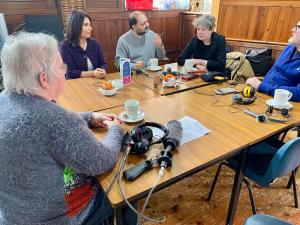
Decentered Media provided valuable opportunities and a platform to view and approach issues from a neutral standpoint, which was crucial for me as a researcher. It offered an insider’s view of a community media setup that I had not experienced before. I met interesting, dedicated individuals like Helen Pettman, editor of the Evington Echo, who remains a prominent figure for all Leicester residents because of her ongoing service, even in her eighties. I engaged in meaningful discussions about Leicester’s media landscape, representation, identity, structures, funding, and what was missing that could have prevented or minimised harm during the 2022 unrest, from the media’s point of view.
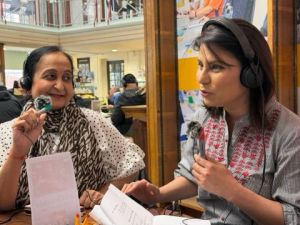
 I helped highlight women’s perspectives in the Soar Sound output. My interview with Deborah Knight, the Chief Executive Officer of Quetzal, a charity supporting female survivors of childhood sexual abuse, addressed a very sensitive subject: how the media can cover the issue more sensitively and responsibly to prevent further trauma for survivors and ensure the issue is not weaponised for political motives.
During my placement with Decentered Media, I became more aware of the consultation process for reinventing the BBC, including the review of its charter and the views of communities in Leicester about it. I learned what they want from the BBC and in what form they want it to continue in the future. I also gained insight into the perspectives of local media practitioners on Ofcom’s review of broadcast licensing – how they demand investment in a diverse range of trusted radio services as an essential part of democratic and social life.
 A key highlight of my stay in Leicester was the publication of the SOAS-led independent inquiry report into the 2022 communal violence. Since I was involved with this topic through my own research, there wasn’t much in the report that was truly new for me; however, I was able to gather many interesting insights from the events organised since its release. Among the community gatherings I attended, the interfaith iftar at the Belgrave Community Centre was one of the main events where all Leicester communities came together to break bread. It was full of symbolism. I loved the atmosphere and felt privileged to witness the beginning of a healing process in the city, which had not been in that space before.
I came here to engage with communities, not just to research them. I wanted the community to see me as a resource for whatever I could offer as a long-time former BBC journalist and PhD researcher. Whether it was joining the conversation led by John Coster, the founder of the Documentary Media Centre in Leicester, with high school girls to inspire them to develop as leaders or shining a light on the challenges and contributions of women in community media through the Soar Sound podcast, I did exactly that.
 My research is impact-driven. I aim to contribute to finding solutions for a more resilient, inclusive, and holistic media environment rooted in civic identity. Therefore, I co-organised the workshop with Rob Watson, the director of Decentered Media, on the role of independent and community media in tackling communalism in Leicester, at De Montfort University. It was a follow-up to the SOAS-led report on the 2022 unrest. The event was attended by local community media leaders and practitioners. We discussed how the media can foster common ground, contribute to social cohesion, and promote interculturalism.
I did a lot of listening in long interviews with Leicester-based journalists, community workers and leaders, and local politicians, as well as in informal discussions with ordinary citizens. People shared their frustrations, aspirations, anger, and hurt, for which I am eternally grateful. It would not be fair not to acknowledge the support of the Arts and Humanities Council, which funded my expedition to Leicester, and the WRoCAH team for their patience and support in materialising this project. My gratitude to Rob Watson for hosting me.
I have been told that Leicester has embraced me, and I was asked to move here since there is a lot of work to do. This all sounded reassuring; honestly, I felt at home in Leicester. I like to think that I also brought some luck; the needle has started moving since I arrived. I hope there will be many opportunities and positive energy. For now, I am leaving, but I will definitely keep coming back!