
The UK government’s renewed interest in media accuracy and trustworthy news is welcome. It is also overdue.
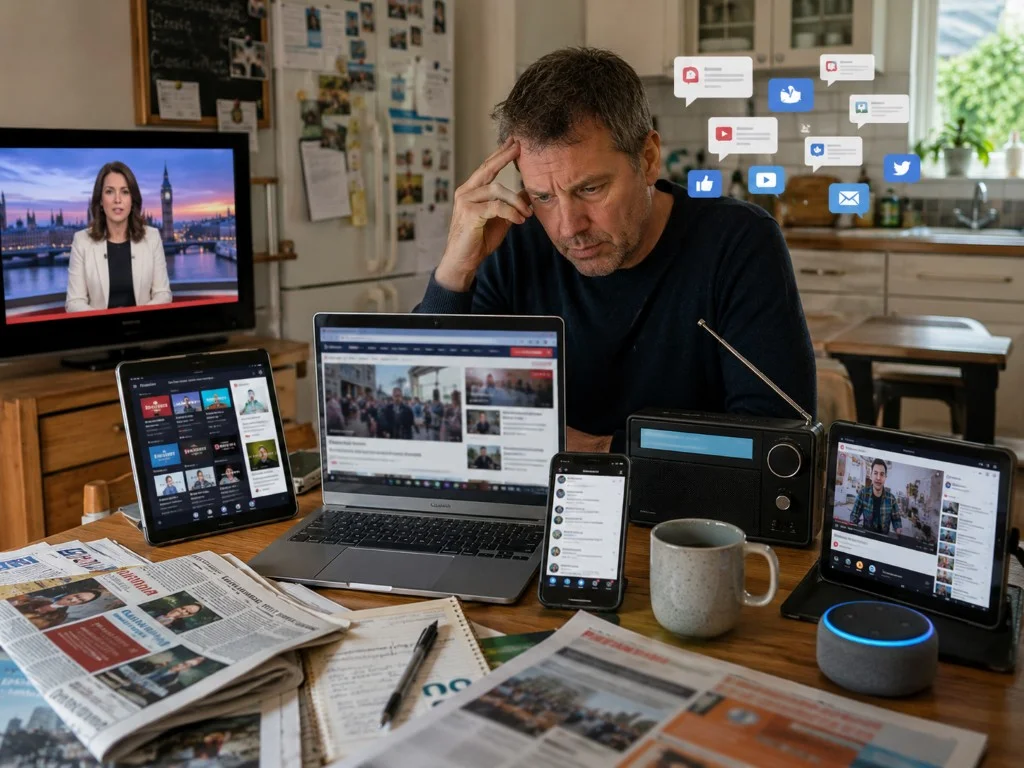
In a media environment shaped by streaming platforms, social video, podcasts, newsletters, online news brands, AI summaries, creator channels and algorithmic recommendation systems, the old assumptions about public trust no longer hold. Audiences do not encounter news and information through a small number of broadcast channels alone. They move across platforms, compare sources, follow creators, reject institutions, seek specialist expertise, and participate in public discussion themselves.
This makes accuracy more important, not less. Public life depends on some shared factual reference points. Democratic debate becomes harder when citizens cannot distinguish between verified reporting, speculation, partisan framing, promotional messaging, synthetic media or deliberate disinformation. A serious public discussion about accuracy is therefore necessary.
However, the way accuracy is defined, regulated and promoted matters. If the answer is simply to give greater prominence to a small number of legacy public service media institutions, then the debate risks becoming too narrow. Worse, it risks returning us to a media system based on scarcity, institutional authority and limited public choice.
Accuracy is the right question, but not the only question
The central challenge is not whether accuracy matters. It does. The real question is who gets to define accuracy, who gets recognised as trustworthy, who benefits from prominence, who is excluded, and what mechanisms exist when trusted institutions themselves fail.
Accuracy should not be treated as a private professional virtue that happens behind newsroom doors. It should be visible, testable and open to public scrutiny. News providers that claim public trust should be able to explain how they verify material factual claims, how they handle uncertainty, how they correct errors, how complaints are processed, and how corrections are made visible to the people who encountered the original mistake.
This points towards an accuracy assurance model. Such a model would not ask government to decide truth. Nor would it ask Ofcom, or any other regulator, to become an arbiter of political opinion. Instead, it would require powerful media organisations to demonstrate their systems of accountability.
That distinction is essential. A democratic accuracy regime should regulate transparency, process, correction and public accountability. It should not become a state mechanism for determining acceptable opinion.
Trust should be earned, not inherited
One of the risks in the present debate is that “trusted news” may become a proxy for legacy status. A broadcaster or publisher may be long-established, widely recognised and professionally staffed, but that does not automatically mean its editorial culture is plural, its assumptions are open to challenge, or its correction systems are visible and effective.
Public service media institutions have a vital role, but they should not be treated as permanently self-validating. Trust should be renewed through practice. It should be earned through openness, accountability, responsiveness and a demonstrable commitment to serving citizens rather than simply protecting institutional authority.
If public prominence is granted to certain news providers, then eligibility must be conditional. It should depend on published editorial standards, accessible complaints systems, transparent correction practices, public reporting, independent review, clear AI provenance rules, and evidence that corrections travel with content across platforms.
Public benefit should carry public responsibility. But public responsibility should not become a closed door that only established providers can pass through. It must be open to innovators and challengers as well.
The danger of institutional capture
A major caveat is needed. If public service media is defined too narrowly, and limited to a small number of legacy providers, then the danger of institutional capture is not adequately anticipated.
Institutional capture does not have to mean crude party-political control. It can also take the form of professional groupthink, monocultural assumptions, metropolitan bias, class homogeneity, narrow recruitment pathways, ideological convergence, bureaucratic defensiveness, or an inability to see beyond the worldview of the organisation itself.
The BBC illustrates why this issue cannot be avoided. The BBC remains one of the most important media institutions in the UK. It has a unique civic role, significant public obligations and an unmatched place in the national media settlement. But that does not mean it should be treated as immune from capture, drift or institutional self-interest.
Recent discussion about the BBC’s increasing focus on international audiences raises legitimate questions. If BBC News places greater strategic emphasis on global audiences, international reach and commercial growth, then UK citizens are entitled to ask how this affects the BBC’s public mission. The BBC can serve international audiences and still provide a strong domestic public service, but these priorities are not identical. They involve different incentives, different audiences and different forms of accountability.
If the BBC Charter renewal embeds a stronger focus on international commercialisation, then the democratic question becomes sharper. Who is the BBC primarily accountable to? UK licence fee payers and citizens? Global audiences? Commercial partners? Government soft-power objectives? Platform distribution deals?
These questions should not be dismissed as hostility to the BBC. They are questions of public accountability. A public service institution must be able to explain clearly whom it serves, how it is held to account, and how its public purposes are protected from commercial or institutional drift.
Citizens need a standing role, not just a complaints route
Another weakness in the present media policy process is that citizens are usually positioned as consultees, audiences, users or complainants. They are rarely given a standing role in shaping the policy and practice of media accountability.
This matters because citizens live with the consequences of media failure. They experience inaccurate reporting, poor correction practices, opaque complaints systems, distorted public debate and the narrowing of civic information. Yet, they are often invited into the process only after major decisions have already been framed by government, regulators, broadcasters, publishers and platforms.
A complaints system is not the same as democratic accountability. Complaints usually happen after harm has occurred. They also place the burden on individuals to identify a breach, understand a process, persist through escalation, and wait for an institutional response. That is not enough.
If accuracy and trust are to become prominent principles in the UK media regulatory process, citizens should have a recognised role in shaping how these principles operate. This might include citizens’ panels, public editors, local media juries, complaints journey audits, correction visibility reviews, and periodic public assessment of how trustworthy news criteria are being applied.
The point is not to make citizens into editors. Editorial independence matters. The point is to ensure that media accountability is not designed solely by the institutions being held accountable.
Would audiences choose a return to scarcity?
The debate about trusted news also has to face a practical question. How many viewers of YouTube, podcasts, newsletters, independent video channels and creator-led media would want to return to a world in which news and information are supplied by a small number of approved providers?
Platforms such as YouTube are not neutral public spaces. They are commercial systems with opaque algorithms, uneven moderation, attention-driven incentives and serious misinformation risks. But they have also enabled a major expansion in who can publish, explain, investigate, document, criticise and educate.
For many users, the broad range of content creators is not a problem to be solved. It is the value of the system. People can find specialist knowledge, minority perspectives, independent commentary, local documentation, lived experience, technical expertise and alternative forms of explanation that would never have found space in a traditional broadcast schedule.
This does not mean that all creators are accurate. Nor does it mean that platform markets automatically produce truth. But it does mean that any regulatory attempt to promote trusted news must be careful not to reduce diversity of supply.
A democratic media policy should not ask citizens to return to a narrow information order. It should ask how a plural media ecology can become more accountable, more transparent and more accurate without collapsing back into institutional scarcity.
Accuracy can be tested in two ways
There are two broad ways that accuracy can be tested.
The first is institutional regulation. This includes editorial codes, Ofcom rules, complaints systems, correction duties, public reporting, independent audit and sanctions for serious or repeated failures. This route is necessary because media markets do not always reward accuracy. They can reward speed, outrage, spectacle, ideological comfort and emotional intensity.
The second is market and social validation. Audiences test media providers through use, trust, comparison, subscription, sharing, criticism, withdrawal of attention and public challenge. Independent creators and smaller publishers are often corrected rapidly by audiences, peers and rival sources. This route is also necessary because formal institutions can become slow, defensive, complacent or monocultural.
Neither route is sufficient on its own. Institutional regulation without pluralism can become paternalistic. Market validation without accountability can become a race for attention. A healthy democratic media system needs both.
The task is to build a media ecology in which powerful institutions are transparent and accountable, platforms are not allowed to dominate distribution without responsibility, and citizens retain meaningful choice across a wide range of providers.
Community, civic and local media must be part of the answer
One of the persistent failures of UK media policy is the underinvestment in community, civic, local independent and participatory media. These organisations are often closer to the communities they serve than national broadcasters or large publishers. They can work with local knowledge, local relationships, lived experience and forms of accountability that are grounded in place.
Given the right support, community and civic media platforms could provide localised information services to a high standard. They could contribute to public-interest reporting, media literacy, local emergency communication, democratic participation, civic deliberation and community representation.
But this requires investment. It requires training, infrastructure, legal support, shared verification tools, sustainable funding, technical capacity, correction templates, public-interest partnerships and access to local data. It also requires policy recognition that public service media is not only something delivered by large national institutions.
If public service media is understood as a function rather than simply an institutional category, then many more providers could contribute. Local independent publishers, community radio stations, civic media groups, cooperative newsrooms, specialist public-interest creators and participatory media projects could all play a role, provided that standards are transparent and proportionate.
This would strengthen accuracy by strengthening pluralism. It would also recognise that citizens do not only need media about them. They need media with them, near them and, where possible, made by them.
The role of government is pluralism, not prescription
The role of government should not be to prescribe a single system of trusted information. Nor should it compel citizens to accept one approved hierarchy of media authority.
The role of government should be to maintain the conditions for a plural, accountable and resilient media ecology. That means setting fair rules, preventing platform dominance, requiring transparency from powerful institutions, supporting public-interest media, and ensuring that citizens can access a wide range of accurate and accountable sources.
Government should not choose editorial winners. It should not license truth. It should not use accuracy as a route to viewpoint control. But it should ensure that organisations receiving public benefit, regulatory privilege or platform prominence meet clear standards of transparency and accountability.
This includes the BBC. It includes commercial public service broadcasters. It includes major news publishers. It should also include any platform or provider that benefits from a recognised trusted-news regime, including individuals who are using the improved media technologies available to them to build their audiences through the techniques of social media influencing.
At the same time, smaller and community-based providers should not be crushed by disproportionate compliance burdens. Accuracy duties should scale according to reach, risk and public benefit. The larger the influence, and the greater the public advantage, the stronger the transparency obligation should be.
Accuracy should widen the media ecology, not narrow it
The renewed focus on accuracy should be welcomed. But it should not be allowed to become a route back to a closed media order.
The future of public service media should not be reduced to protecting a small number of legacy providers from digital disruption. Nor should the public be asked to accept that institutional authority is the same thing as trust. Public service media should be plural, accountable, participatory and open to renewal.
The BBC and other legacy providers have important roles, but they should not define the outer boundary of public value. A stronger media settlement should support national institutions where they serve citizens well, while also enabling local, community, civic, independent and creator-led media to contribute to the public information environment.
Accuracy and trust need serious consideration in the UK media regulatory process. But they must be considered alongside pluralism, citizen agency, institutional accountability and diversity of supply.
The aim should not be to make everyone subscribe to one system. The aim should be to ensure that citizens have access to many accountable systems, many voices, many forms of expertise and many routes to challenge error.
Questions for discussion
- Who should decide what counts as trustworthy news?
- Should public service media be defined by legacy institutions, or by public-value functions that a wider range of providers can fulfil?
- How can accuracy be made visible without turning regulators into arbiters of contested truth?
- What standing role should citizens have in shaping media standards and reviewing complaints systems?
- How can the BBC remain accountable to UK citizens if its strategic priorities increasingly include international audiences and commercial revenue?
- Would platform users accept a system that gives priority to a small number of approved news providers, or would this be experienced as a reduction in media choice?
- What investment would be needed for community, civic and local independent media to provide trusted local information services?
- How do we build a media ecology that is accurate without being closed, plural without being chaotic, and accountable without being controlled?
The debate starts with trust, but it cannot end there
Trust is not a label that can simply be awarded. It is a relationship that has to be built, tested, corrected and renewed.
If the UK is to place accuracy and trust at the centre of media regulation, then it must avoid the temptation to equate trust with institutional familiarity. A democratic media system should not be designed around nostalgia for scarcity. It should be designed around citizens’ needs in a plural, networked and participatory media age.
Accuracy matters. Public service matters. The BBC matters. But so do citizens, creators, local publishers, community media groups and independent civic voices.
The task now is not to narrow the media ecology in the name of trust. It is to make a wider media ecology more trustworthy.